
Survey first: $300–$750
A recorded camera run with distances marked. Yours to keep, and usually credited if the work goes ahead.
We camera the line first, show you what is actually wrong, and then tell you whether relining is the right answer. Often it is. Where the pipe has collapsed or lost its fall, it is not, and we will say so rather than sell you a liner that disappoints.
A resin-saturated liner is drawn into the existing pipe through an access point, inflated so it presses against the wall, and cured until it hardens. What you are left with is a continuous pipe inside the old one, with no joints along its length and a slightly smaller bore than the original.
Nothing is excavated, and the cured surface is smoother than the clay or concrete it lines, so flow is typically maintained or improved despite the small loss of diameter. On a property where a driveway, mature garden or paving sits over the line, that is the whole argument.
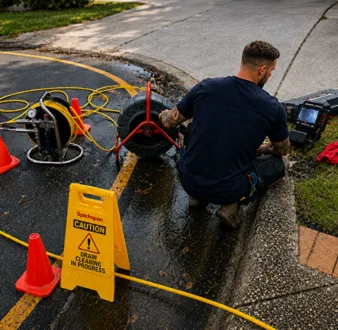

The apartments around the former Nestlé site (Abbotsford Cove) share drainage lines, blockages here need a camera to diagnose and the right access to clear.
In a strata building the line between lot property and common property decides who pays, and it is worth settling before a quote rather than after. A branch serving your lot alone is generally yours; the stack it joins and anything in common property generally is not.
Relining changes the arithmetic here because it is usually cheaper than the alternative for a shared line, and because it can be done without opening ceilings in the lots below the fault. That tends to make the approval conversation shorter.
Many Federation and interwar homes still run on original pipework that’s prone to cracks, sags and collapses. CCTV shows us exactly what’s going on.
On a period property the drainage repair is rarely the expensive part. Tessellated verandah tiles, original brick paving, a mature garden or a heritage-listed frontage all cost far more to reinstate than the pipe underneath costs to fix.
That is the argument for trenchless in one sentence. The liner is drawn through an existing opening and cured in place, so the surface above is never disturbed and there is nothing to match, replace or explain to council.
Low-lying riverside blocks can flood in heavy rain when stormwater pits and lines are blocked. We clear them and keep them flowing.
Ground near water holds more of it, sits lower and moves more through the seasons than ground further up. Pipework laid decades ago has been flexed by that movement for its whole life, and joints open a fraction at a time rather than failing all at once.
It is why faults here tend to arrive as a slow decline rather than a sudden break, and why a camera often finds a run that is uniformly tired instead of one obvious defect. That pattern suits a full-length liner rather than a patch.
On a clay line the barrel is usually fine. What has gone is the mortar or rubber ring at each joint, and there is one every few hundred millimetres, which is a great many small openings after sixty or eighty years in the ground.
Abbotsford’s established, tree-lined streets mean roots love finding their way into older clay sewer lines, one of the top causes of blockages here.
That matters for the quote. You are not replacing a pipe, you are sealing a long series of joints, and a liner does the whole run at once rather than patching them one at a time.
Most people associate relining with sewers, but stormwater suffers the same failures and reline just as well: cracked lengths, open joints, roots, and sections that have silted because the fall has flattened. On a property that floods in every serious downpour, the line is often the reason rather than the rain.
The camera run matters more here than anywhere. Clearing a surcharging pit at the height of a storm tells you almost nothing; the same line inspected on a dry day tells you whether you have a blockage or a defect.
The reason excavation is painful in an apartment block is access. A line under a slab, a car park or a common courtyard means noise, disruption and lots that cannot use their bathrooms while it happens.
A liner installed from an existing access avoids nearly all of that. What still needs planning is the water shutdown, and buildings usually require notice for it, so the schedule matters as much as the method.
Where the water table sits close to the pipe, every open joint is an entry point. The line runs fuller than it should year-round, silt comes in with the water, and the system behaves as though it is undersized when it is simply leaking inward.
Abbotsford sits on a leafy peninsula in Sydney’s Inner West (postcode 2046), wrapped by the Parramatta River and bordering Five Dock, Chiswick, Wareemba and Canada Bay. It’s a suburb of two halves for drains, and we know both well.
Sealing the run changes that immediately, and it is one of the clearest before-and-after results relining produces. It is also the case most often missed, because nothing looks broken from the surface.
A recorded camera run with distances marked. Yours to keep, and usually credited if the work goes ahead.
The prevailing 2026 Sydney range for residential sewer relining.
Proportionate for one fault in a sound run. We will recommend it over a full liner when that is what the camera shows.
For a run failing along its length, which on old clay is the common finding.
Plus reinstatement. On a bare lawn it can win. Under anything you would miss, it usually does not.
Figures reflect the 2026 Sydney market rather than a quote. You get your own number once we have seen inside the pipe. Figures here are indicative of the 2026 Sydney market rather than a quote from us, you get your own number as a fixed price before any work starts.

Nothing is priced until a camera has been down the line. The survey is recorded, distances are marked from a known point, and the footage is yours.
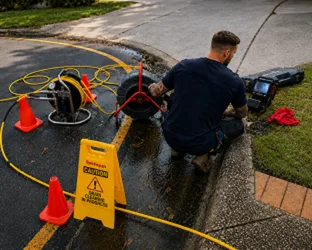
A single defect in a sound run wants a patch. A run failing along its length wants a full liner. A collapsed or sagging section wants excavation. The camera decides, not the quote.
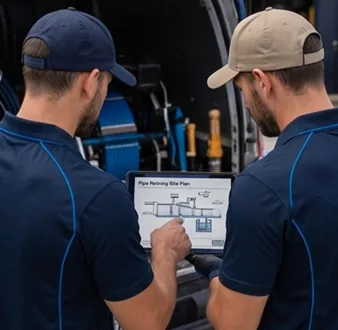
Jet clean, install through the existing opening, cure in place. Water is off for part of the day and nothing above the pipe is disturbed.

Junctions reinstated, final camera run, and the compliance paperwork where the work is notifiable. You keep both recordings.
Describe what the drain is doing and how often. We will tell you whether it sounds structural or whether a clean and a maintenance interval is the honest answer.
Cost, lifespan, method, and the cases where a liner is the wrong answer.

Call for the fastest answer, or send the form and we will arrange a camera survey before anything is quoted.

Leave your details and our local Abbotsford team will call you back fast.