
Call-out fee, $80–$180
What most Sydney plumbers charge to attend. Ask for it up front, anyone who will not name it on the phone is telling you something.
When water is coming through the ceiling, the useful question is not "who opens at eight", it is "who answers now". We do. Around the clock across Abbotsford, a licensed plumber picks up, talks you through making it safe, and gets a crew moving.
Split a night shift with us and you would see the same short list on repeat: mains-pressure water escaping from a burst or a failed flexi hose, sewage rising through the lowest floor waste after roots close the line, hot water tanks letting go after years of quiet corrosion, and the gas smell nobody wants to be wrong about. Every one of them shares a rule, the damage compounds while you wait. First job on the phone is stopping that: for water, the meter’s stop valve, turned clockwise, buys you calm while the van is moving.
And then there are the calls people feel silly making, the only toilet in the apartment out of action, a drain backing up the evening before settlement, a unit block’s shared stack misbehaving on a Sunday. Make the call anyway. Between Abbotsford, Five Dock, Drummoyne, Chiswick and the rest of the Inner West, someone from our crew is always on, and after-hours means a plumber at your door, not a message bank.


Low-lying riverside blocks can flood in heavy rain when stormwater pits and lines are blocked. We clear them and keep them flowing.
Heavy rain arriving on a high tide is the combination that fills yards near the water. Stormwater that normally drains away has nothing to drain into, so it backs up through the pits instead, which is why a blocked line around here shows itself in the garden long before it shows itself indoors.
If your yard has filled more than once, the pit is telling you something. Clearing it during the storm is emergency work; finding out why it filled is a twenty-minute camera run on a dry day, and considerably cheaper.
Original earthenware gives way at the joints, and it rarely announces itself politely. Roots find the joint, the joint opens, and the section finally lets go on a night with the house full and one bathroom working.
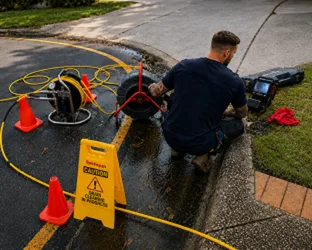
Many Federation and interwar homes still run on original pipework that’s prone to cracks, sags and collapses. CCTV shows us exactly what’s going on.
Old pipe is not automatically bad pipe. But when a heritage-era line fails once, it is worth knowing whether you have had one bad joint or a tired run. We clear it, camera it before we leave, and you keep the footage: so any decision about relining is yours to make on evidence rather than on our word.
The apartments around the former Nestlé site (Abbotsford Cove) share drainage lines, blockages here need a camera to diagnose and the right access to clear.
Before anything else, work out whether the failure sits inside your lot or on common property, because that decides who authorises the work and who is billed. As a rule of thumb: a fixture, a tap or pipework serving only your apartment is usually yours; a stack, a shared sewer line or a stormwater pit serving the building is usually the owners corporation's.
If it is after hours and the building manager is unreachable, we attend, make it safe, and write the report so it names the line and the lot. That report is what settles the invoice question later, and it is far easier to produce on the night than to reconstruct a fortnight afterwards.
If it is happening right now: stay out of moving water, lift what you can off the floor of the garage, and clear any grate you can reach safely from dry ground. Do not lift a surcharging pit lid, the water underneath is moving faster than it looks.
Once the rain stops, the pit that overflowed usually has a reason, and it is rarely the rain. Silt, roots or a collapsed section will do it, and the difference matters because one of those is a clean-out and the others are a repair.
Ground close to the water holds more of it, sits lower, and moves more than ground further up. Over decades that shows up in the drainage as joints that have opened slightly, falls that have flattened, and lines that silt where they once ran clean.
Abbotsford sits on a leafy peninsula in Sydney’s Inner West (postcode 2046), wrapped by the Parramatta River and bordering Five Dock, Chiswick, Wareemba and Canada Bay. It’s a suburb of two halves for drains, and we know both well.
None of that is an emergency by itself. It is the reason an emergency here often turns out to be the last stage of something that has been developing quietly, and why the camera run after the clear is worth more than the clear.
What most Sydney plumbers charge to attend. Ask for it up front, anyone who will not name it on the phone is telling you something.
Against roughly $120–$160 in business hours. Nights, weekends and public holidays sit at the top of the range.
Call-out, the first stretch of labour and minor parts, for the common jobs: an isolated burst, a blocked toilet, a failed valve.
Slab leaks, gas line faults and anything needing walls opened at 2am climb quickly. You will know the number before we start, not after.
If it can genuinely hold, isolated, contained, water off: we will say so on the phone and book you for daylight rates instead.
The figure is agreed with you before the work happens, at any hour, no exceptions. Figures here are indicative of the 2026 Sydney market rather than a quote from us, you get your own number as a fixed price before any work starts.
The person answering can actually help: what to shut off, whether it truly needs tonight, and a straight ETA for Abbotsford.
Emergency vans carry the usual suspects, pipe, valves, hoses, drain machines, because a fix that waits for a supplier is not an emergency fix.
Damage stops first. Then the repair is priced, fixed, and you say yes or no with the number in front of you.

Almost always completed on the spot. Where a genuine part order is unavoidable, you are left sealed, safe and running until it arrives.
Two minutes describing it on the phone settles it. Genuine hold-overs get booked at daytime rates, genuine emergencies get a van.
The phone is the fast lane, any hour. After-dark form enquiries ring the on-call plumber directly, nothing waits for office hours.

Leave your details and our local Abbotsford team will call you back fast.